Elliot Washor's TGIF 04.24.2026
- Elliot Washor

- Apr 24
- 4 min read
Are you with me now? A J Ryder

The School of Athens by Raphael - Get a Grip
“I think it gives you a little bit more of an independent ground to stand on against claims of expertise,” Crawford said. Tradesmen don’t earn their status by “passing through the gates of some institution and being conferred with titles and credentials,” he continued. “It’s based on knowing how to do your shit.” Michael Crawford – Shopcraft as Soulcraft
This week sparked many conversations and readings about work we’ve been doing for over 30 years—work that is now gaining wider attention, especially around skilled trades and schooling. Many people lament the disappearance of shop class, and while there are valid reasons for that concern, most education systems in the U.S. and elsewhere still miss a deeper issue. They have yet to move beyond the false divide between head and hands, between the senses and rational thought.
Schools continue to treat these as separate domains. In contrast, a central aim of our work has always been to integrate hand, head, heart, and health. Few others take this approach. Instead, many efforts to elevate skilled work focus on making it more academic, rather than making academics more grounded in embodied, hands-on experience. As the saying goes, “think with your senses, feel with your mind.”
This tension is not new—Plato and Aristotle debated it thousands of years ago—and it continues to shape education in ways that limit students’ growth. Given our recent work in the skilled trades, the question now is whether we can bring these elements even closer together, helping the broader system see that integration leads to more meaningful lives. This echoes what W.E. B. Du Bois and others argued: education must aim for more than simply producing workers.
Now for this week’s hand journey

About a week ago, Andrew asked me to put together a two-pager for the BPL board to understand the impact on our latest work in the skilled trades in New Jersey. As an effort to elevate the trades as a truly unified system for developing the whole person, it would be a joy to write—especially given our long history in this space. At BPL, we’ve been engaged in this work for over 30 years through initiatives and convenings like Making Their Way in the World, Harbor Freight Fellows, and the Redesign of CTE.
But as I began thinking through the two-pager, a series of timely meetings and readings pushed me to reflect even more deeply. The first was a note from a dear friend, Doug Stowe, filled with personal quotes about handwork and craft. Doug has spent five decades as a founding member of the Eureka Springs School for the Arts in Arkansas and was a frequent participant at BPL Hand Conferences. Like me, he has long been a strong proponent of Sloyd education—a Finnish/Swedish model centered on handicraft, emphasizing character development, manual skill, and cognitive growth.
At the turn of the last century, Sloyd played a significant role in American education. It was grounded in the idea of moving from the concrete to the abstract, giving students opportunities to work with wood, clay, metal, and textiles—to understand the physical world through making. After all, how do we create music or anything else without these rapid, integrated exchanges of mind, body, and spirit? At a high level of mastery, this becomes deep learning: the kind where action flows naturally, sometimes without conscious articulation—not magic, but second nature.
Sloyd represents a path we were once on. But over time, we lost that direction, adopting instead a more industrialized, Prussian model of schooling designed for mass efficiency and cost savings rather than holistic development.
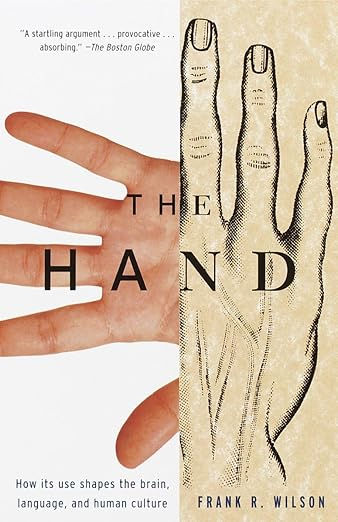
Shortly after hearing from Doug, Frank Wilson sent me an article on St. Joseph’s, a new Catholic college for the skilled trades based in Steubenville, Ohio – Saving a Lost Generation of Young Men. And, at the same time Scott Boldt sent me another in his series of connecting BPL practice to philosophers and practitioners of merit. This time coincidentally, the piece was on Frank. Scott’s series started about 27 years ago. For those who don’t know, Frank brought his findings about the hand and who we are as a species to light for the world in his book, The Hand: How Its Use Shapes the Brain, Language, and Human Culture.
I also watched a documentary produced by Robert Redford about Buck Brannaman, a real life “Horse Whisperer” who played a major role in the Redford movie, The Horse Whisperer. I’ve met two Horse Whisperers and rode with them to learn if their practices and philosophies are similar to BPL. Sure enough there’s loads of connections. This documentary hits these similarities pretty hard, especially around horses and people facing their traumas and how the use of the hands and touch is such an integral part of the healing process.
Then on Tuesday at our International Big Picture Learning Credential (IBPLC) while meeting with Viv, Andrea and JR, out of the blue Viv brought up a question about adding an eighth learning frame that dealt with tactile/tacit learning. Because of their academic origin, she felt that our learning goals don’t give hand learning enough visibility around how you are smart. A day later at one of Andrea’s IBPLC meetings, we had a short discussion over lunch with Robert Fung and advisors at the San Diego Met on this topic. To be continued…
With all the constant talk about AI, hardly anything brought up in this TGIF involves AI or way of shortcutting without knowing. Here shortcuts are discovered when you learn something really well and develop these rules of thumb or heuristics because you embody the skills. These are shortcuts that live within us, not outside of us. Beverly Sills – aka Bubbles, the world-famous opera singer and graduate along with actress Mae West, Noble Laureate Barbara McClintock and singer/actress Stephanie Mills from Brooklyn’s Erasmus Hall stated, "There are no shortcuts to any place worth going." She would know.
Next week, I’m in San Diego working with Andrea and Taylor on IBPLC Professional Development and moving the New Jersey along.
Be well. El


Comments